Lesson 07 — Reading Health Information and Deciding Together
Learners apply a five-question test to health claims they hear — who made it, why, for whom, what evidence, what is left out — building on Grade 10's source-evaluation work. They then learn shared decision-making: a clinician brings knowledge, the learner brings their own life, values, and preferences, and the two decide together — including where traditional medicine fits as a valued tradition to weigh, not a rival to dismiss.
Objectives
Objectives
- D03.S4.11.01 Plan for their own health-care needs, including how to access care, advocate for themselves, and navigate health systems.
Essential question
How do I read a health claim for what it is, and share a decision with a clinician instead of just receiving one?
Key vocabulary
Materials
Standard materials
- Health-claim cards · 1 set per group Real-feeling claims (a cure-all, a supplement, a viral "tip") to run through five questions
- Five-questions organizer · 1 per learner who made it, why, for whom, what evidence, what is left out
Low-tech / no-cost
- Paper and pencil Write the five questions and apply them to claims spoken aloud or remembered
- Claim cards (handwritten) Learners can write claims they have heard and test them
Enriched / lab & device
- A printed health claim from a real advertisement or article · 1 per group To test the five questions against a real-world example
Works in different contexts
- large-group Test one claim whole-class on the five questions, then small groups each test a different claim and report
- multi-age Younger learners ask "who made it and why"; older learners run all five questions and weigh evidence against motive
- self-directed A learner tests three claims alone, writes which one they would trust and why, and names a decision they would still make with a clinician
- level-grouped Group by reading comfort; a ready group also compares a scientific claim with a traditional-medicine account and asks what each offers
- outdoor-only Read claims aloud in a circle and walk each through the five questions as five steps across the ground
Lesson 7 — Reading Health Information and Deciding Together
Summary
Learners apply a five-question test to health claims they hear — who made it, why, for whom, what evidence, what is left out — building on Grade 10’s source-evaluation work. They then learn shared decision-making: a clinician brings knowledge, the learner brings their own life, values, and preferences, and the two decide together — including where traditional medicine fits as a valued tradition to weigh, not a rival to dismiss.
Objectives
- Evaluate a health claim for source and evidence, and describe how a person shares a care decision with a clinician. (D03.S4.11.01)
Connection
Health advice is everywhere — a cure-all in a feed, a supplement behind a counter, a “doctors don’t want you to know” headline. Some of it helps, some is harmless, some is profitable to someone. And even with good information, a decision is not a clinician’s alone: you are the one who has to live with the choice — its cost, its side effects, its fit with your beliefs and daily life. Reading claims and deciding together are two halves of the same skill.
Materials
- Health-claim cards
- Five-questions organizer
Preparation
- Copy the claim cards and five-questions organizer.
- Retrieval: from Grade 10 (D03.S4.10.02), evaluating health information sources. Today we sharpen the question set and add shared decision-making.
- Prepare one worked example: run a single claim through all five questions aloud.
Facilitator note
This lesson is written to the learner (“you”). The ideas to land: any health claim opens with five questions — who made it, why (help, belong, or sell), for whom, what evidence, what is left out (NAMLE’s key questions, S-151; the five core concepts, S-442). Then shared decision-making: a clinician contributes knowledge; the learner contributes their life, values, and preferences; the decision is made together, and a second opinion is always available. Traditional medicine is held respectfully: it is a real, valued knowledge tradition that many people use alongside formal care (S-145) — the lesson weighs it on the same five questions, not as an enemy. Claims-and-evidence structure follows Toulmin’s claim/data/warrant (S-236).
The critical-thinking lens: this is the lesson’s spine — source, motive, evidence, omission. The global lens: different cultures hold different traditions of healing, all worth a fair hearing. The ethics lens: deciding together is an ethical stance — the learner’s life is not a clinician’s to override. Model the five questions explicitly (S-011). Preview: Lesson 8 pivots to living with long-term conditions.
Procedure
- Recall (5 min). From Grade 10: what made a health source trustworthy? Today we sharpen the questions and add the decision side.
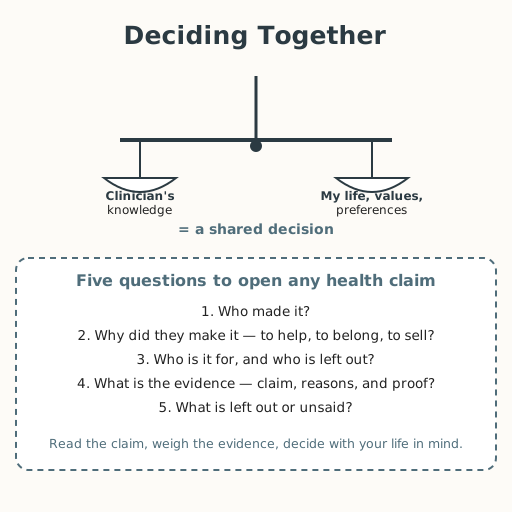
- Meet the five questions (10 min). Run any health claim through five questions: Who made it? Why — to help, to belong, or to sell? Who is it for, and who is left out? What is the evidence — claim, reasons, proof? What is left out? (S-151, S-442). Notice the claim/evidence/warrant shape: every claim needs reasons and proof (S-236).
- Test the claims (12 min). In pairs, run three claim cards through the five questions. Mark each: trust, doubt, or “need more.” Notice how often “who made it and why” predicts the rest.
- Deciding together (10 min). A good decision has two inputs on the scale: the clinician’s knowledge, and your life — your values, your daily routine, what you can afford, what fits your beliefs. When both weigh in, that is shared decision-making. You can always ask for time, bring someone, or seek a second opinion.
- Traditional medicine, weighed fairly (8 min). Many people use traditional medicine alongside clinics — it is a real, valued knowledge tradition, not a lesser option (S-145). Run a traditional remedy through the same five questions, and ask: what does it offer, what does the evidence say, and how might it sit alongside other care? The point is respectful weighing, not ranking one system above another.
- Write it (8 min). In your journal: one claim you would trust and why, one you would doubt and why, and one decision you would still want to make with a clinician rather than alone.
- Close (2 min). Say the five questions from memory, without looking.
Differentiation
- Support: Ask only two questions of each claim (“who made it” and “why”), and name one thing you would want your clinician to know about your life.
- Extension: Take a real advertisement or article, run all five questions in writing, and draft a short “buyer’s guide” a friend could use before trusting a health product.
Assessment
- Formative (peer + self): Can the learner run the five questions on a claim, explain trust or doubt with reasons, and describe shared decision-making with a second-opinion option?
- Portfolio artifact (unit): The five-questions organizer plus the written trust/doubt/decide reflection.
Home connection
Find one health claim your household has heard (a food, a remedy, an app). Run it through the five questions together and write the household’s verdict.
Resources
- On the key questions for analyzing any message (including health claims): NAMLE (S-151); Center for Media Literacy, five core concepts (S-442).
- On claim/data/warrant structure: Toulmin, The Uses of Argument (S-236).
- On traditional, complementary, and integrative medicine as a valued tradition: World Health Organization (S-145).
- On worked examples and guided practice for an evaluation skill: Kirschner, Sweller & Clark (2006) (S-011).