Lesson 08 — Living with a Chronic Condition
Learners build an honest, non-stigmatizing picture of life with a long-term condition: the extra steps a day can hold — medicine, monitoring, pacing, rest, clinic visits, energy planning — and the reality of invisible conditions. They map a day, separate the condition from the person, and begin to ask what support would actually help.
Objectives
Objectives
- D03.S4.11.02 Explain how chronic conditions and disabilities affect daily life and design respectful support for themselves and others.
Essential question
How does a long-term health condition shape a day, and how do I think about it without reducing a person to it?
Key vocabulary
Materials
Standard materials
- A-day-with-a-condition organizer · 1 per learner A morning/noon/night timeline to add the steps a condition brings
- Condition case cards · 1 set per group Plain, non-stigmatizing vignettes of common long-term conditions to analyze
Low-tech / no-cost
- Paper and pencil Draw a timeline and add steps by hand
- Index cards Write one "what I might need" and one "what I might offer" note
Enriched / lab & device
- A first-person account of living with a condition · 1 per group To read the lived reality in someone's own words, respectfully
Works in different contexts
- large-group Build one shared timeline whole-class, then pairs each map a different condition's day and share what surprised them
- multi-age Younger learners name what a condition might add to a day; older learners analyze pacing, monitoring, and invisible conditions
- self-directed A learner maps one condition's day alone, then writes what they now understand and one support they would offer
- level-grouped Group by reading comfort; a ready group also weighs the difference between a visible and an invisible condition and its stigma
- outdoor-only Walk the timeline as stations outdoors, adding steps aloud at each stop to feel the day lengthen
Lesson 8 — Living with a Chronic Condition
Summary
Learners build an honest, non-stigmatizing picture of life with a long-term condition: the extra steps a day can hold — medicine, monitoring, pacing, rest, clinic visits, energy planning — and the reality of invisible conditions. They map a day, separate the condition from the person, and begin to ask what support would actually help.
Objectives
- Explain how a chronic condition affects daily life, without reducing a person to the condition. (D03.S4.11.02)
Connection
Some health needs are not a single event but a thread through every day — a medicine to take, a number to watch, energy to ration, a rest built into the afternoon. A person living this way is not “their condition”; they are a whole person whose day has extra steps. Understanding those steps — and that some conditions are invisible to everyone else — is the difference between support that helps and sympathy that misses the mark.
Materials
- A-day-with-a-condition organizer
- Condition case cards
Preparation
- Copy the organizer and case cards.
- Retrieval: from Lessons 1–7, the kinds of care and the skills of accessing and advocating. Today we turn from systems to living with a condition.
- Prepare case cards that are plain, specific, and non-stigmatizing (no “suffering” language; the person first, the condition second).
Facilitator note
This lesson is written to the learner (“you”). The ideas to land: a chronic condition is a long-term health need that threads through a day — medicine, monitoring, pacing, rest, clinic visits, energy planning — and some conditions are invisible, so others may not see the cost. The deep value, held firmly: the condition is not the person; a person-first frame (a person with diabetes, not “a diabetic”) protects dignity, and no body is worth less for needing more steps (philosophy §4, §12 — value, not fact). Because the registry has no page-level source for specific condition taxonomies, keep medical specifics minimal and general, and let the case cards carry the detail through learner research rather than asserting unverified medical facts.
The physical lens: reading what a day actually costs a body. The social-emotional lens: invisible conditions and stigma — how being unseen or misjudged adds its own weight. The egalitarianism lens: everyone deserves support designed for their day, not a one-size template. Guard the room: some learners live this reality or love someone who does; hold it with care and never require disclosure. Preview: Lesson 9 widens from conditions to disability and barriers.
Procedure
- Recall (5 min). From Lessons 1–7, you planned access, navigation, and advocacy for episodes of care. Today: what if the need does not end — it recurs every day?
- Meet a chronic condition (8 min). A chronic condition is a health need that lasts a long time and needs ongoing management. It is not who a person is; it is something they live with — so we say “a person with asthma,” never “an asthmatic.” The condition is part of a day, not the definition of a person.
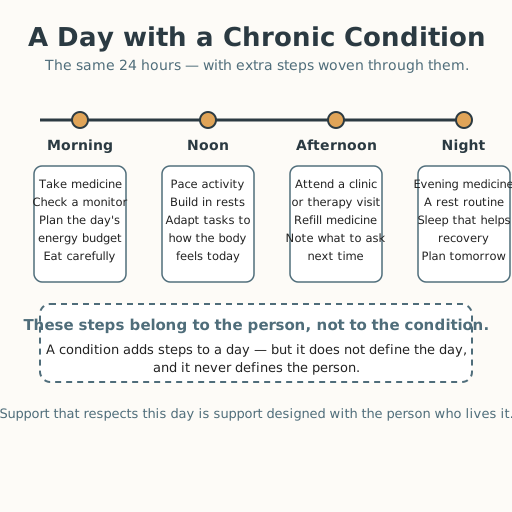
- Map a day (14 min). Using the organizer, map the extra steps one condition might add: morning (medicine, a check, planning the day’s energy), noon (pacing activity, building in rests), afternoon (a clinic or therapy visit, a refill), night (evening medicine, a rest routine, sleep that aids recovery). See the day lengthen — the same 24 hours, more steps.
- The invisible cost (8 min). Some conditions are invisible — they show no outward sign, so others may not believe the cost is real. That disbelief, and the stigma it feeds, is itself a burden the person carries on top of the condition. What could make an invisible day more visible without forcing disclosure?
- Separate person from condition (8 min). Read a case card and answer three questions: what does this person’s day hold, what is hardest about it, and what is true about this person that has nothing to do with the condition — their work, their humor, their plans?
- Write it (8 min). In your journal: one thing you now understand about living with a condition, and one support you would actually offer — phrased as an offer, not a rescue.
- Close (4 min). Say why “a person with a condition” and “a person is their condition” lead to two very different kinds of support.
Differentiation
- Support: Map only morning and night steps for one condition, and say one thing about the person beyond the condition.
- Extension: Compare a visible and an invisible condition’s day, and write how stigma differs between them and what fair support would address in each.
Assessment
- Formative (peer + self): Can the learner map a day’s added steps, name the invisible/stigma dimension, and describe the person apart from the condition?
- Portfolio artifact (unit): The completed day map plus the written reflection, kept for the unit’s support design.
Home connection
Notice one routine in your own home that exists because of someone’s health — a medicine, a rest, a food rule. Write what it adds to the day and one thing that makes it easier or harder.
Resources
- On adolescent health and wellbeing as a general frame for daily health needs: World Health Organization, Adolescent health (S-261); Mental health of adolescents (S-311).
- On the value commitment that every body and every pace is honored (value, not fact):
docs/philosophy.md(§12, end is health and flourishing).