Lesson 07 — My Values in Action
Learners move from *claiming* values to *living* them. They learn the concept of the value-action gap — the distance between what we say we stand for and what we actually do when it costs us — and they name, honestly, one gap in their own life and one concrete commitment to close it. Integrity is reframed not as perfection but as the habit of shrinking the gap.
Objectives
Objectives
- D01.S2.12.01 Articulate an integrated sense of who they are, what they value, and how they will act, holding together across contexts.
Essential question
How do I make my actions actually match my values, especially when the situation pushes against them?
Key vocabulary
Materials
Standard materials
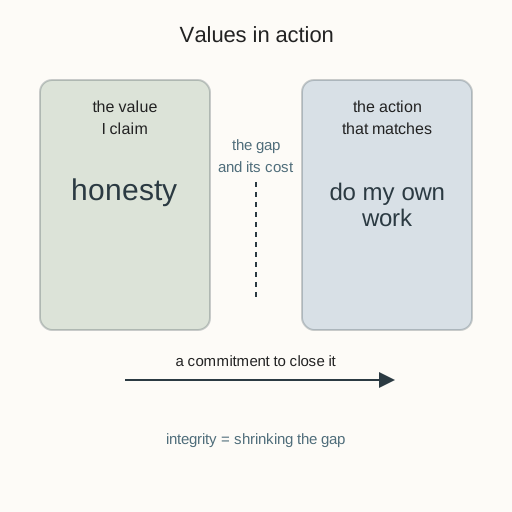
- Value-action map · 1 per learner A two-column organizer — the value I claim, and the action that would (or would not) match it — with a space to name the gap and its cost
- Pressure scenarios · 1 set per pair Four situations where a value is under pressure (a deadline tempts cheating, a group mocks someone who is absent, a good job requires hiding a part of oneself, a friend asks for a loyalty that harms a third person)
Low-tech / no-cost
- Paper and pencil To draw the map and write one commitment by hand
Enriched / lab & device
- One plain-language page on values-to-behavior gaps · 1 per pair A short page on how even strongly held values can fail to show up in action when the cost is high, to frame the honesty step
Works in different contexts
- large-group Work one scenario whole-class, then pairs each take a second and share the gap they found
- multi-age Younger learners match one value to one action; older learners name the gap, its cost, and a commitment
- self-directed A learner completes the map alone, names their largest value-action gap, and writes one commitment to close it
- level-grouped A ready group also analyzes *why* the gap opens (cost, fear, habit) and which lever would close it
- outdoor-only Two zones — "I claim this" and "I actually do this" — walk from one to the other and name what stands between them
Lesson 7 — My Values in Action
Summary
Learners move from claiming values to living them. They learn the concept of the value-action gap — the distance between what we say we stand for and what we actually do when it costs us — and they name, honestly, one gap in their own life and one concrete commitment to close it. Integrity is reframed not as perfection but as the habit of shrinking the gap.
Objectives
- Articulate values and align them with action, holding an integrated self together under real pressure. (D01.S2.12.01)
Connection
It is easy to be honest when honesty costs nothing, and easy to be fair when fairness is free. The test of a value is what you do when it costs — when the deadline tempts you to copy, when the group is unkind and silence is safer, when a good opportunity asks you to hide a part of who you are. Everyone has a gap between what they claim and what they do. Integrity is not having no gap; it is noticing it and deliberately closing it, a little, every time you choose.
Materials
- Value-action map
- Pressure scenarios
- Paper and pencil (low-tech)
- Values-to-behavior page (enriched)
Preparation
- Copy or draw the value-action map; prepare the pressure scenarios.
- Retrieval: from Lesson 6, the through-line (“in every room I am still the person who ___”). Today we test whether actions live up to that line.
- Prepare plain definitions (model once: Kirschner, Sweller & Clark, S-011): integrity is consistency between claimed values and real action; a value-action gap is the distance between them, which widens when the cost of living the value rises. Hold these as description, never as a moral score on any learner.
Facilitator note
This lesson is written to the learner (“you”). The idea to land: values are tested by their cost, and integrity is the habit of noticing and shrinking the gap — not a state of perfect consistency. Even strongly held values can fail to appear in behavior when the situation makes them expensive, which is why the lesson asks for honesty about the gap rather than shame about it.
The ethics lens: living a value is an ethical act, and the gap is where ethics becomes real. The egalitarianism lens: the cost of living a value is not the same for everyone — speaking up can cost a privileged person comfort and a marginalized person their safety; honor that difference rather than moralizing. The global lens: values are named and ranked differently across cultures and traditions; a learner’s value set is theirs to articulate, never to be corrected toward any single canon. The critical-thinking lens: the honest naming of a gap is a check on self-flattery — exactly the kind of check this unit trains.
Safeguarding: scenarios are one step removed and chosen to avoid demanding disclosure of trauma or family distress. If a learner names a real gap that is genuinely risky (e.g., safety, abuse), do not treat it as a classroom exercise — redirect to appropriate support.
Procedure
- Recall (5 min). From Lesson 6: what was your through-line sentence? Today we test whether your actions would keep that promise under pressure.
- Meet the gap (10 min). Work a model example (S-011): a student who “values honesty” faces a deadline and a friend’s completed paper. The claimed value is honesty; the matching action is doing their own work; the gap is the temptation, and its cost is the grade risk. Name the parts, then the honest question: where does my gap open?
- Map a scenario (12 min). In pairs, take a pressure scenario. Name the value it tests, the action that would match it, and the cost that opens the gap.
- Name your own gap (10 min). Privately, in your capstone journal, write one value you claim and one place your action falls short of it — and name the real cost that makes it hard.
- Make a commitment (10 min). Write one concrete, small commitment that shrinks that gap this week — specific enough that a friend could check it.
- Close (5 min). Say why integrity is a direction you keep choosing, not a score you either have or lack.
Differentiation
- Support: Match one value to one action, and name the gap only for the easiest scenario.
- Extension: Write the commitment as an if-then plan (“If I face ___, then I will ___”) and test it against a second scenario.
Assessment
- Formative (peer + self): Can the learner name a value, the action that matches it, a real gap and its cost, and a concrete commitment?
- Portfolio artifact (unit): The value-action map with the commitment, kept in the capstone journal (feeds Lesson 10).
Home connection
Share one value you hold with someone at home and ask them where they have seen you live it — and where they have seen the gap. Write one sentence on what you heard.
Resources
- On worked examples for a new reflective skill: Kirschner, Sweller & Clark (2006) (S-011).
- On self-regulation strategies that turn intention into action (if-then planning): Duckworth, Gendler & Gross (2016) (S-097).
- On spaced retrieval across the unit: Dunlosky et al. (2013) (S-039).