Lesson 08 — Authoring, Not Inheriting
Learners distinguish *inheriting* an identity from *authoring* one. They map the forces that shaped them — family, culture, place, peers, media — and then name the choices they have made *about* those forces: what they keep, what they revise, what they refuse. They meet the four descriptive identity statuses as a way to locate themselves in the authoring process without being ranked.
Objectives
Objectives
- D01.S2.12.01 Articulate an integrated sense of who they are, what they value, and how they will act, holding together across contexts.
- D01.S2.12.02 Explain how they author their identity within global, cultural, and technological forces rather than being defined by them.
Essential question
How do I author my identity within the forces that shaped it, rather than being merely defined by them?
Key vocabulary
Materials
Standard materials
- Authoring map · 1 per learner A two-part organizer — the forces that shaped me (family, culture, place, peers, media) on the left, and the choices I have made *about* them (kept, revised, refused) on the right
- Identity-status cards · 1 set per pair Four descriptive statuses — explored and committed, exploring, committed without exploring, neither — to recognize where a person is in authoring an identity
Low-tech / no-cost
- Paper and pencil To draw the authoring map and write one kept/revised/refused row by hand
Enriched / lab & device
- One plain-language page on identity statuses · 1 per pair A short page on the four identity statuses (explored/committed, etc.), presented as a descriptive framework, never a ranked ladder
Works in different contexts
- large-group Brainstorm the shaping forces whole-class, then individuals each complete the kept/revised/refused column
- multi-age Younger learners name one thing they were given (a language, a custom) and whether they keep it; older learners complete the full map and argue about a force they refused
- self-directed A learner completes the map alone and writes one sentence on the difference between what shaped them and what they chose
- level-grouped A ready group also locates a person in a dilemma on the identity-status cards and argues about what "exploration" looks like in that case
- outdoor-only Two zones — "what I inherited" and "what I authored" — stand in each while naming an example, then stand on the line between for the in-between ones
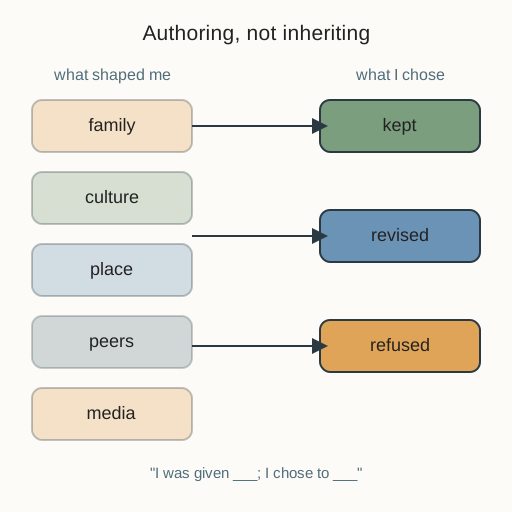
Lesson 8 — Authoring, Not Inheriting
Summary
Learners distinguish inheriting an identity from authoring one. They map the forces that shaped them — family, culture, place, peers, media — and then name the choices they have made about those forces: what they keep, what they revise, what they refuse. They meet the four descriptive identity statuses as a way to locate themselves in the authoring process without being ranked.
Objectives
- Articulate how identity is authored within shaping forces rather than merely received, and locate themselves in that process. (D01.S2.12.01, D01.S2.12.02)
Connection
You did not choose the language you first spoke, the family you were born into, the place you grew up, or the stories that filled the air around you. Those forces shaped you before you could consent. But they are not the whole story of you. At some point you began to do something with what you were given — keep a custom, revise a belief, refuse a label, choose a value your surroundings never offered. That is authorship: not escaping the forces, but deciding what to do with them.
Materials
- Authoring map
- Identity-status cards
- Paper and pencil (low-tech)
- Identity-status page (enriched)
Preparation
- Copy or draw the authoring map; prepare the identity-status cards.
- Retrieval: from Lesson 6, the integrated self; from Grade 10 (D01.S2.10.01), identity as socially and historically constructed. Today we add the agentive turn: authorship.
- Prepare plain definitions (model once: Kirschner, Sweller & Clark, S-011): inheritance is what shapes us before we choose; authorship is the choosing we do about it. The four identity statuses — whether a person has explored options and committed to them — are a descriptive framework (Marcia, S-403), never a ladder, and “moratorium” (open exploration) is a normal, healthy phase, not a defect. Social identity is the part of self drawn from group membership, which can form even around trivial or arbitrary lines (Tajfel, S-232).
Facilitator note
This lesson is written to the learner (“you”). The idea to land: identity is authored — chosen about — not merely received, and authorship happens within forces, not outside them. The four statuses describe how (exploration vs. commitment), and are offered as description with explicit non-ranking (Marcia, S-403): open exploration is healthy and expected at this age. Group membership shapes identity even when the groups are arbitrary (Tajfel, S-232), which is why the lesson asks learners to notice which groups have quietly shaped them.
The ethics lens: what we refuse and what we keep is an ethical choice — about what kind of person we will be. The egalitarianism lens: some people are allowed to author freely and others are defined by forces they did not choose (race, class, disability, migration status); authorship is a right unevenly granted, and that unevenness is itself a thing to notice. The global lens: the forces that shape identity — family, culture, place — differ everywhere; a village inheritance and a megacity inheritance are both real and neither is the default. The critical-thinking lens: the map is a check that separates “I was given this” from “I chose this” — the core move of authorship.
Safeguarding: learners name forces they choose; no one is required to disclose marginalized identities, migration history, or family rupture. Honor refusal and silence.
Procedure
- Recall (5 min). From Grade 10: how is identity shaped by society and history? Today we add the other half — what you do with that shaping.
- Meet inheritance vs. authorship (10 min). Work a model example (S-011): a young person inherits a family craft and a family expectation to continue it. Inheriting is the craft and the expectation; authoring is choosing to carry it on, transform it, or leave it. Name the three moves: keep, revise, refuse.
- Map your forces (12 min). On the left, list the forces that shaped you (family, culture, place, peers, media). On the right, for each, mark kept, revised, or refused — and one sentence on why.
- Meet the statuses (8 min). With a partner, read the four statuses and locate a person in a dilemma (not yourself) on them. Note: “still exploring” is healthy, not a failure.
- Write the authorship sentence (10 min). Complete: “I was given ___; I chose to ___.” Name one force you refuse and one you keep, and why each is yours.
- Close (5 min). Say why authorship is not escape — it is choosing inside the forces that shaped you.
Differentiation
- Support: List two forces and mark each kept/revised/refused, leaving the statuses for later.
- Extension: Write the authorship sentence, then test it: what force would you add to your map that your surroundings never offered, and why?
Assessment
- Formative (peer + self): Can the learner distinguish inheritance from authorship, map a force to each of keep/revise/refuse, and write a clear authorship sentence?
- Portfolio artifact (unit): The completed authoring map, kept in the capstone journal (feeds Lesson 10).
Home connection
Ask someone at home about one thing they inherited and what they chose to do with it (keep, revise, or refuse). Write one sentence on how their choice compares to yours.
Resources
- On identity statuses (exploration vs. commitment): Marcia, Development and Validation of Ego-Identity Status (S-403).
- On social identity and group membership: Tajfel, Experiments in Intergroup Discrimination (S-232).
- On worked examples: Kirschner, Sweller & Clark (2006) (S-011); on spaced retrieval: Dunlosky et al. (2013) (S-039).