Lesson 07 — Mental Health and Medical Care: Managing Your Own Health
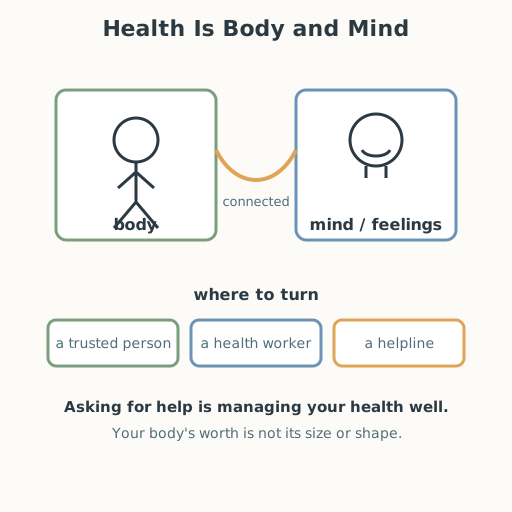
Learners integrate mental health and medical care into independent health management: they distinguish mental health (everyone has it) from mental illness (a treatable health condition, never a character flaw), practice noticing when they need support, and build a "where to turn" plan — a trusted person, a health worker, a helpline. They learn to self-advocate in a health system, and they touch body image and eating-disorder prevention with dignity and no shame.
Objectives
Objectives
- D03.S4.12.01 Manage their own health independently, integrating sleep, movement, nutrition, mental health, and medical care.
Essential question
How do I manage my own mental health and get the medical care I need — including knowing when to ask for help and how to advocate for myself?
Key vocabulary
Materials
Standard materials
- Two-halves-of-health sheet · 1 per learner A body side and a mind/feelings side, each with a "notice" line, an "act" line, and a shared "where to turn" line
- Health & care journal · 1 per learner The unit-long notebook for reflections and portfolio artifacts
Low-tech / no-cost
- Paper and any writing tool A hand-drawn two-halves sheet works identically
- One's own experience and a trusted person in mind Help-seeking is practiced by naming who you would turn to — no device or data needed
Enriched / lab & device
- A local/regional list of real help resources · 1 per learner or pair Helplines, clinics, and trusted adults — age-appropriate and locally accurate, gathered by the facilitator
Works in different contexts
- large-group Model the worked example whole-class, then learners complete their sheet in pairs and share only what they choose to
- multi-age Younger learners name one feeling and one person they would tell; older learners also map how to find and use care
- self-directed A learner builds the two-halves sheet alone and writes the "where to turn" plan
- level-grouped A ready group also distinguishes mental health (everyone has it) from mental illness (a treatable condition, not a character flaw)
- outdoor-only Use a quiet outdoor spot to practice a calming breath and name one person or place to turn to for help
Lesson 7 — Mental Health and Medical Care: Managing Your Own Health
Summary
Learners integrate mental health and medical care into independent health management: they distinguish mental health (everyone has it) from mental illness (a treatable health condition, never a character flaw), practice noticing when they need support, and build a “where to turn” plan — a trusted person, a health worker, a helpline. They learn to self-advocate in a health system, and they touch body image and eating-disorder prevention with dignity and no shame.
Objectives
- Manage their own health independently, integrating sleep, movement, nutrition, mental health, and medical care. (D03.S4.12.01)
Connection
Health is not only a body that works — it is also a mind that can rest, feel, and ask for help. Managing your own health means knowing how to notice when something is off and where to turn, for your mind as much as your body. Every person has mental health, just as every person has physical health; and every person, at some point, needs help. Asking for it is not weakness — it is exactly what managing your own health looks like.
Materials
- Two-halves-of-health sheet
- Health & care journal
- Low-tech: paper and any writing tool; one’s own experience and a trusted person in mind
- Enriched: a local/regional list of real help resources
Preparation
- Copy or draw the two-halves sheet (body / mind-feelings, each with “notice” and “act,” plus a shared “where to turn”).
- Retrieval: from Grade 9 (D03.S4.09.02), recognizing signs of mental-health struggle and where to seek help; from Grade 11 (D03.S4.11.01), planning one’s own health-care access and self-advocacy. Today we join mental and physical care into one independent practice.
- Prepare the worked example (one filled-in side) to model first (S-011).
Facilitator note
This lesson is written to the learner (“you”). The idea to land: managing your own health includes your mind — noticing when you need support, knowing where to turn, and advocating for yourself in care — and asking for help is a strength, never a weakness. Teach one filled-in side as a worked example, then let learners build their own plan (S-011). This is emotionally sensitive content: keep it calm, normalizing, and non-alarming; never require a learner to disclose; frame help-seeking as ordinary. If a learner shows signs of distress, follow your local safeguarding path quietly and promptly (S-051).
The ethics lens: a person’s mind deserves the same care and respect as their body, and a person in distress deserves belief and support, never judgment. The egalitarianism lens: mental-health care is not equally available — cost, stigma, and location gate it — and recognizing that inequality is part of advocating for yourself and others. The global lens: cultures understand and speak of mental health in different ways, and no culture has a monopoly on wellbeing; the WHO frames adolescence as a formative time for building the habits of mental wellbeing (S-311). The technology lens: digital media can both lift (connection, learning) and weigh down (comparison, disrupted sleep) — and digital tools can also connect a person to help, but never replace a trusted human (S-311). The environment lens: a safe, quiet, green place is itself a support for mental health — environment is part of care. Note on body image: worth is never measured in size or shape; body positivity means appreciating what a body does, not how it looks (S-407, S-411). Preview: Lesson 8 weaves everything into one lifelong plan.
Procedure
- Recall (5 min). From Grade 9: name one sign that you or someone else might need support, and one place to seek it. Today we make that into a plan we can run ourselves.
- Meet the idea (8 min). Write it down: mental health is a part of everyone’s health — how you feel, think, and cope. Mental illness is a health condition (like a physical illness) that can be treated — it is not a character flaw. Asking for help is a skill, not a failure.
- Worked example — notice, act, turn (15 min). Model the three moves on the sheet. For the mind side: notice (sleep or mood or interest has changed for a while, S-311), act (a small self-care step — rest, movement, talking to someone you trust), turn (a trusted person, then a health worker or helpline if it persists). For the body side: notice (a pain or change that lingers), act (basic self-care), turn (a clinic or health worker). Write both on your sheet.
- Name the move — self-advocacy (8 min). Self-advocacy is speaking up for your own care: saying what you feel, asking questions, and asking again if you are not heard. Write one sentence you could say to a health worker to describe what you need.
- Guided practice (12 min). With a partner, complete your “where to turn” plan: one trusted person, one place to get care, one helpline or number if you know it. Exchange only what you choose to; check each other’s structure (is there a person, a place, and a way to get more help?), never the details. Say — or write, sign, gesture, or use AAC to show — the first person you would tell.
- Body image, with dignity (5 min). Write one sentence that is true: my body’s worth is not its size or shape — it is what it lets me do and feel (S-407). If food or body thoughts ever become loud or constant, that is a reason to turn to help, not a secret to keep (S-411, S-286).
- Close (2 min). Say — or write, sign, gesture, or use AAC to express — why asking for help is a sign of managing your health well, not badly.
Differentiation
- Support: Use the sheet pre-filled with the worked example; the learner adds one name (a trusted person) and one sentence rather than building the whole plan.
- Extension: Distinguish mental health from mental illness in your own words, and write what you would say to a friend who was afraid that asking for help meant weakness.
- Number access (dyscalculia): This lesson requires no arithmetic; any helpline number is copied, not computed, and may be stored as a picture, a saved contact, or a written note rather than a memorized numeral.
- Communication access: Every spoken step — saying, naming, reading aloud, discussing, or closing — can be done in writing, sign, gesture, or AAC instead. Learners who are non-speaking, d/Deaf, hard-of-hearing, or who use AAC complete every task in their preferred mode; no step requires producing or hearing sound. A “where to turn” plan may be drawn, signed, or shown rather than spoken.
Assessment
- Formative (peer + self): Can the learner distinguish mental health from mental illness, name the notice–act–turn moves, and build a “where to turn” plan (person, place, more help)?
- Portfolio artifact (unit): The completed two-halves-of-health sheet with the “where to turn” plan and the body-image sentence, opened in the journal.
Home connection
At home, identify — without disclosing anything you would rather keep private — one trusted person you could turn to and one small way you already support your own mental health. Write one sentence for each.
Resources
- On worked examples and guided practice for a new concept: Kirschner, Sweller & Clark (2006) (S-011).
- On adolescent mental wellbeing: WHO — Mental health of adolescents (S-311); WHO — Mental health (S-504).
- On positive body image and worth beyond appearance: Tylka & Wood-Barcalow (S-407); NEDA — Body Image (S-411).
- On recognizing and responding to eating-disorder warning signs: Nemours KidsHealth (S-286).
- On safeguarding (believe, don’t promise secrecy, report): WHO — Preventing violence against children (S-051); on the right to health: UNCRC (S-060).