Lesson 08 — Putting It Together: A Lifelong Health Plan
Learners synthesize sleep, movement, nutrition, mental health, and medical care into a single, adaptable lifelong health plan — the capstone artifact for independent health management. They retrieve and weave together the unit's earlier pieces (a spaced-recall payoff), write what they will keep and what they will adjust, and commit to revisiting the plan as their body and life change. The plan is personal, revisable, and free of any judgment of a body.
Objectives
Objectives
- D03.S4.12.01 Manage their own health independently, integrating sleep, movement, nutrition, mental health, and medical care.
Essential question
How do I weave sleep, movement, nutrition, mental health, and medical care into one plan I can actually keep — and keep revising — for the rest of my life?
Key vocabulary
Materials
Standard materials
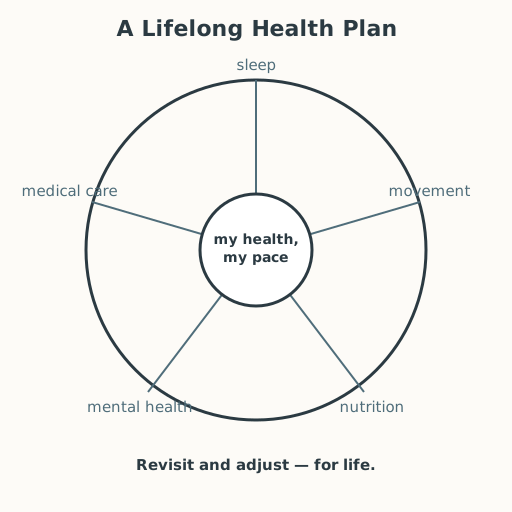
- Lifelong-health wheel sheet · 1 per learner Five spokes — sleep, movement, nutrition, mental health, medical care — around "my health, my pace," each with a "what I'll keep" and a "what I'll adjust" line
- Health & care journal · 1 per learner The unit-long notebook; this lesson's artifact becomes the S4.12.01 capstone
Low-tech / no-cost
- Paper and any writing tool A hand-drawn five-spoke wheel works identically
- The learner's own completed sheets from Lessons 6 and 7 The sleep-movement-nutrition pillars and the where-to-turn plan, revisited and woven together
Enriched / lab & device
- A one-page plan template (digital or printed) · 1 per learner A clean layout for the final plan, if a learner prefers to type or format it
Works in different contexts
- large-group Review the five areas whole-class, then learners assemble their wheel in pairs, sharing only what they choose
- multi-age Younger learners name one thing from each area they already do; older learners also write the "adjust" line that makes the plan revisable
- self-directed A learner assembles the five-spoke wheel alone and writes the revisit-and-adjust commitment
- level-grouped A ready group also adds a "life change" scenario (leaving home, illness, aging) and revises one spoke in light of it
- outdoor-only Assemble the wheel on the ground or in a journal using natural markers for the five spokes
Lesson 8 — Putting It Together: A Lifelong Health Plan
Summary
Learners synthesize sleep, movement, nutrition, mental health, and medical care into a single, adaptable lifelong health plan — the capstone artifact for independent health management. They retrieve and weave together the unit’s earlier pieces (a spaced-recall payoff), write what they will keep and what they will adjust, and commit to revisiting the plan as their body and life change. The plan is personal, revisable, and free of any judgment of a body.
Objectives
- Manage their own health independently, integrating sleep, movement, nutrition, mental health, and medical care into one lifelong, adaptable plan. (D03.S4.12.01)
Connection
A plan is not a prison — it is a map you draw and redraw. The point of everything in this unit is not a perfect score but a life you can keep tending, decade after decade, as your body and circumstances change. Today you gather the pieces you have already built and set them down as one plan — yours, for life, and yours to revise.
Materials
- Lifelong-health wheel sheet
- Health & care journal
- Low-tech: paper and any writing tool; your own completed sheets from Lessons 6 and 7
- Enriched: a one-page plan template
Preparation
- Copy or draw the five-spoke wheel (sleep / movement / nutrition / mental health / medical care around “my health, my pace,” each with “keep” and “adjust”).
- Retrieval: this lesson is the unit’s spaced-recall pass — pull forward Lessons 6 and 7 (and the nutrition through-line from Lessons 1–3). Recalling across days is itself a science-of-learning strength (S-039).
- Prepare the worked example (one spoke’s keep/adjust) to model first (S-011).
Facilitator note
This lesson is written to the learner (“you”). The idea to land: independent health management is not five separate rules but one integrated, revisable plan — and revisiting it is part of the plan, not a failure of it. Model one spoke’s keep/adjust as a worked example, then let learners assemble their own wheel, retrieving the unit’s earlier work (S-011, S-039). Celebrate the plan as a living thing: a learner who revises is succeeding, not slipping. Never grade a body, a number, or a habit; grade the integration — that all five areas are present and thoughtfully connected.
The ethics lens: a plan you make for your own life is a promise to yourself — make it one you can keep and one that treats you with kindness rather than punishment. The egalitarianism lens: every body, every ability, every budget can hold a lifelong plan — the plan adapts to the person, never the person to some fixed ideal. The global lens: a lifelong plan looks different in every culture and climate — a plan that works in one place may not in another, and that variety is health, not failure. The technology lens: tools can log your plan, but the plan is yours — a tool should serve it, not run it, and no tracker knows your life better than you do. The environment lens: your environment — housing, air, green space, safety — shapes what plan is even possible, so the plan must include tending the conditions of health, not only the habits. Preview: Lessons 9 and 10 turn outward, to caring for others and emergency response.
Procedure
- Recall (5 min). From memory — without looking — name the five areas of independent health you have built in this unit. Then check yourself against Lessons 6 and 7. This retrieval is how the learning sticks (S-039).
- Meet the idea (8 min). Write it down: a lifelong health plan is one integrated picture of how you will tend sleep, movement, nutrition, mental health, and medical care — plus a promise to revisit and adjust it as your life changes.
- Worked example — one spoke (10 min). Model the “keep and adjust” pair for one area. For example, sleep: keep — a roughly consistent bedtime that fits your life; adjust — shift it when work, study, or family need it, and notice how you feel. Write it on the wheel as the model.
- Weave your wheel (15 min). For each of the five spokes, write one thing you will keep and one thing you will adjust. Draw them onto your wheel around the hub my health, my pace. Pull from your own earlier sheets — this is your plan, not a template.
- Name the move — revisit (5 min). The plan is never finished. Write the commitment: I will revisit this plan when my body, my work, or my life changes, and adjust it without shame.
- Share and check (8 min). With a partner, show only the structure of your wheel (all five spokes present, a keep and an adjust each). Check each other: is every area tended, and is the plan kind rather than punishing? Say — or write, sign, gesture, or use AAC to show — one thing you will adjust first and when.
- Close (2 min). Say — or write, sign, gesture, or use AAC to express — what it means for a plan to be “for life, and yours to revise.”
Differentiation
- Support: Use the wheel pre-filled with one “keep” per spoke; the learner adds one “adjust” per spoke rather than building both from scratch.
- Extension: Choose a life-change scenario (leaving home, an illness, aging, a move to a new climate) and revise one spoke in light of it, writing what stays and what changes.
- Number access (dyscalculia): This lesson requires no arithmetic; the five spokes are handled by the pre-printed wheel, and every spoke may be completed in words, drawings, or gesture with no numerals at all.
- Communication access: Every spoken step — saying, naming, reading aloud, discussing, or closing — can be done in writing, sign, gesture, or AAC instead. Learners who are non-speaking, d/Deaf, hard-of-hearing, or who use AAC complete every task in their preferred mode; no step requires producing or hearing sound.
Assessment
- Formative (peer + self): Can the learner name all five areas from memory, and produce a wheel with a “keep” and an “adjust” for each, connected into one kind, revisable plan?
- Summative / portfolio artifact (unit): The completed lifelong-health wheel with the revisit-and-adjust commitment — the S4.12.01 capstone, opened in the journal.
Home connection
At home, share the shape of your plan (the five areas and your one first adjustment) with someone you trust — or, if you prefer, with yourself in writing. Write one sentence about how you will remember to revisit it.
Resources
- On retrieval and spacing as the highest-utility learning techniques: Dunlosky et al. (2013) (S-039).
- On worked examples and guided practice: Kirschner, Sweller & Clark (2006) (S-011).
- On the evidence behind each spoke: AASM sleep (S-050); WHO physical activity (S-069); WHO healthy diet (S-038); WHO mental health (S-311, S-504).