Lesson 03 — How My Values Formed
Learners map where their own values came from — family, community, culture, faith, schooling, peers, media, and lived experience — and reflect on which values they inherited, which they borrowed, and which they are actively choosing. They hold the question of what they value open rather than settling it as a fixed creed, noticing that values are formed, evolving, and partly chosen — a reflection, not a verdict.
Objectives
Objectives
- D09.S1.12.02 Reflect on their own evolving values, how they formed, and how they will test them in the world, holding questions open rather than settling them as creed.
Essential question
Where did my values come from — family, community, culture, faith, media, and lived experience — and which of them are mine, borrowed, or still being formed?
Key vocabulary
Materials
Standard materials
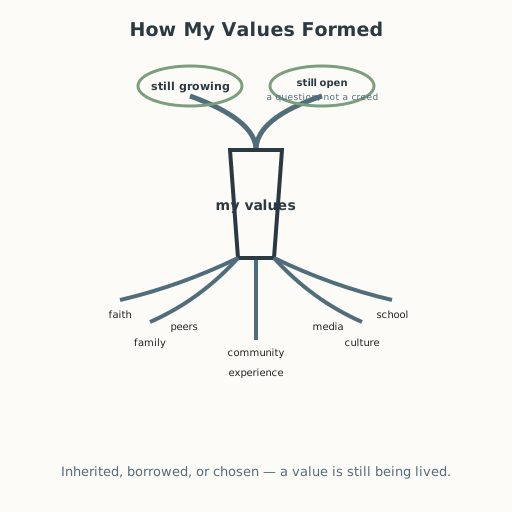
- Values-map sheet · 1 per learner A root-and-branch map: roots for family, community, culture, faith, schooling, peers, media, and experience, feeding a trunk labeled 'my values,' with branches for 'still growing' and 'still open'
- Capstone ethics & civic journal · 1 per learner
Low-tech / no-cost
- Blank paper To draw the values map by hand — roots, trunk, branches
- A small stone or seed A tangible anchor for "what I inherited" vs. "what I am growing"
Enriched / lab & device
- A short personal-essay or memoir excerpt · 1 per pair A writer reflecting on where their values came from, to model the reflective voice
Works in different contexts
- large-group Brainstorm sources of values whole-class, then each learner draws their own map and shares one root
- multi-age Younger learners name who taught them one value; older learners trace roots to branches and mark what is still open
- self-directed A learner draws the map alone and writes a short reflection on one value's origin and one value still forming
- level-grouped A ready group also distinguishes values they *chose* from values they *inherited*, and reflects on that difference
- outdoor-only Sit by a real tree or a growing plant and use its roots-and-branches shape to draw the values map in the earth or on paper
Lesson 3 — How My Values Formed
Summary
Learners map where their own values came from — family, community, culture, faith, schooling, peers, media, and lived experience — and reflect on which values they inherited, which they borrowed, and which they are actively choosing. They hold the question of what they value open rather than settling it as a fixed creed, noticing that values are formed, evolving, and partly chosen — a reflection, not a verdict.
Objectives
- Reflect on their own evolving values, how they formed, and how they will test them in the world, holding questions open rather than settling them as creed. (D09.S1.12.02)
Connection
No one invents their values from nothing. A value — honesty, courage, care, fairness, respect for elders, love of land — usually arrives first as a voice, a practice, a story, or a rule from someone who raised us or a place that shaped us. Some of it we keep, some we question, some we quietly change. Naming where our values came from is not a quiz about loyalty; it is how we come to own what we believe instead of merely carrying it.
Materials
- Values-map sheet
- Capstone ethics & civic journal
- Low-tech: blank paper; a small stone or seed
- Enriched: a memoir excerpt modeling the reflective voice
Preparation
- Copy or draw the values-map sheet; prepare the root labels (family, community, culture, faith, schooling, peers, media, experience).
- Retrieval: from Lesson 2, that values can be weighed but not ranked as “correct”; from Grade 11 (D09.S1.11.02), competing accounts of a good life across traditions. Today we turn the lens on the self.
- Frame this as a private, low-pressure reflection; no learner must disclose anything they wish to keep private.
Facilitator note
This lesson is written to the learner (“you”). The idea to land: values are formed by many influences — family, community, culture, faith, schooling, peers, media, experience — and coming to own one’s values means noticing which were inherited, which were borrowed, and which are being chosen; the question of what one values is held open, not settled as a creed. This is a reflection, not a confession and not a verdict. Protect privacy: learners may share as much or as little as they choose, and there is no “right” set of roots. Do not judge any learner’s values or their sources; the skill is self-awareness, not agreement.
The ethics lens: reflecting on one’s own values is itself an ethical act — the difference between values that are examined and values that are merely carried. The egalitarianism lens: ask whose values get treated as the default and whose are dismissed — a learner whose family’s values are honored in public has a different starting point than one whose are mocked; the classroom must make room for every learner’s roots without ranking them. The global lens: values differ across cultures, and that diversity is a shared human good (S-389); the lesson models that no single culture’s values are the measuring stick. The technology lens: media and screens are now among the loudest teachers of values, and often the least examined — naming “media” as one root invites learners to ask what a feed is quietly teaching them (S-481, S-482). The environment lens: for many people, values are inseparable from a place — land, water, seasons — and the love of a place is a real root, one the map should make room for. Preview: Lesson 4 asks how these values will be tested in the world.
Procedure
- Recall (5 min). From Lesson 2, that values can be weighed but not ranked as “correct.” Today we ask where mine came from.
- Name the roots (10 min). On your map, list the roots: family, community, culture, faith, schooling, peers, media, lived experience. For each, jot one value it planted in you — a one-word value is enough (honesty, courage, care, fairness, respect, love of land…).
- Trace to the trunk (12 min). Write “my values” on the trunk. Move to it the values that feel most yours. For each, mark one of three: inherited (I carry it from my people), borrowed (I picked it up along the way), or chosen (I examined it and claimed it).
- Mark what is still growing (12 min). On the branches, write the values that are still forming and the questions that are still open — the ones you are not ready to settle. Notice: an open question is not a failure; it is a value still being lived (S-001).
- Reflect (12 min). In your journal, write a short reflection: one value, where it came from, and whether you inherited, borrowed, or chose it — and one question you are holding open. Keep it honest and private if you wish.
- Close (4 min). Say — or write, sign, gesture, or use AAC to express — one root that surprised you when you noticed it.
Differentiation
- Support: Use a map pre-labeled with roots and a few example values; the learner underlines 2–3 values and marks inherited/borrowed/chosen with a simple symbol, then writes one sentence.
- Extension: Choose one value you marked “chosen” and write a paragraph on when and why you claimed it — the experience that moved it from borrowed to owned.
- Number access (dyscalculia): This lesson requires no arithmetic. The map is spatial and word-based; nothing must be counted, computed, or ordered. Every step can be drawn, spoken, written, signed, or gestured.
- Communication access: Every spoken step — naming, reading aloud, sharing, or closing — can be done in writing, sign, gesture, or AAC instead. Learners who are non-speaking, d/Deaf, hard-of-hearing, or who use AAC complete every task in their preferred mode; no step requires producing or hearing sound.
Assessment
- Formative (self + peer, optional share): Can the learner trace their values to their sources, mark which were inherited, borrowed, or chosen, and name one value still forming — as a reflection, not a verdict?
- Portfolio artifact (unit): The values map and short reflection, opened in the capstone ethics & civic journal — the strand’s “evolving values” artifact.
Home connection
Ask someone at home: “What is one value you were raised with that you kept, and one you changed?” Write their answer and your own in your journal — two lines each.
Resources
- On self-awareness as a core competency: CASEL — Fundamentals of SEL (S-001).
- On identity and the life story: Marcia — Ego-Identity Status (S-403); McAdams — The Psychology of Life Stories (S-404).
- On cultural diversity as a shared good: UNESCO — Universal Declaration on Cultural Diversity (S-389). On media as a teacher of values: Britannica — Social media (S-481); Pariser — The Filter Bubble (S-482).