Lesson 10 — One Idea, Two Forms
Learners adapt one idea into a second written form for a different audience, applying the purpose-and-audience thinking from Lesson 9. They take the piece they drafted, rewrite it for a new reader, and compare the two versions to name exactly what changed — words, order, and form — and why.
Objectives
Objectives
- D04.S3.05.01 Write for different purposes and audiences, choosing an appropriate style and structure.
Essential question
How do I take one idea and write it in a different form for a different audience?
Key vocabulary
Materials
Standard materials
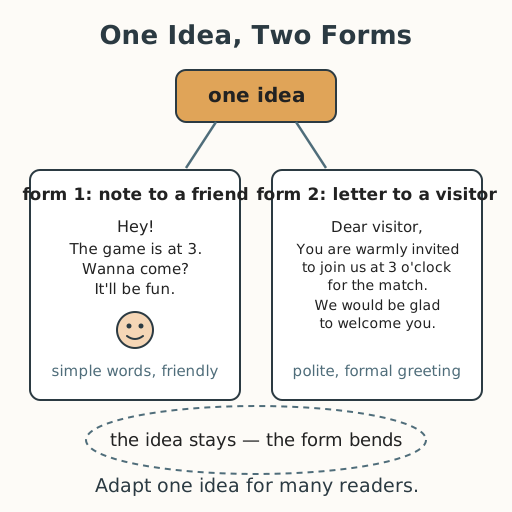
- One idea, two forms poster · 1 A poster showing the same idea written two ways — for example, a friendly step-by-step list and a formal request — with the changes circled
- The learner's piece from Lesson 9 · 1 per learner Each learner brings the piece they drafted for one purpose and audience
- New audience task cards · 1 set per group Cards naming a different audience for the same idea — a younger child, an elder, a visitor, the whole community
Low-tech / no-cost
- Voice and your own piece Speak your piece first one way, then again for a different listener, and notice aloud what changes
- A 'change the audience' game Partners name one idea and take turns saying it to a friend, then to a respected elder, then to a stranger
Enriched / lab & device
- A two-forms comparison chart · 1 A shared chart where learners place their two versions side by side and note what changed and why
- A digital formatting tool · 1 per group To lay out the second form differently (a poster, a letter, a list) where devices are available
Works in different contexts
- large-group Model rewriting one piece for a new audience on the board, circling the changes, then have learners rewrite their own
- multi-age Younger learners change one or two words for a new listener while older learners restructure the whole piece and explain the changes
- self-directed A learner rewrites their piece for a second audience and writes a short note listing the three biggest changes and why
- level-grouped Learners ready to extend produce a third form (for example, a short spoken announcement) and compare all three
- outdoor-only Re-deliver the same message outdoors to two very different listeners — a peer and an elder — and adjust your words and form each time
Lesson 10 — One Idea, Two Forms
Summary
Learners adapt one idea into a second written form for a different audience, applying the purpose-and-audience thinking from Lesson 9. They take the piece they drafted, rewrite it for a new reader, and compare the two versions to name exactly what changed — words, order, and form — and why.
Objectives
- Write for different purposes and audiences, choosing an appropriate style and structure. (D04.S3.05.01)
Connection
A message you’d whisper to a friend becomes different when you say it to a visiting elder, and different again when you post it for the whole community. The idea stays; the form bends. Being able to adapt one idea for many readers is a superpower — it is how a farmer explains a planting plan to a child, a neighbor, and an official, and how a single good idea reaches everyone it needs to.
Materials
- One idea, two forms poster
- The learner’s piece from Lesson 9
- New audience task cards
Preparation
- Print or draw the one idea, two forms poster (same idea in two forms, changes circled).
- Have learners bring their drafted piece from Lesson 9.
- Copy new-audience task cards.
Facilitator note
This lesson is written to the learner (“you”). The idea to land is that adapting form to audience is a real, useful skill, not a busywork rewrite. Model the before/after contrast and circle the changes (simpler words, different greeting, different order, different form). Honor home languages: a learner may adapt into a second language or between two languages, which is advanced and valuable. Keep the focus on fit for the reader, not on grammar errors. Use a worked example first, then let learners revise their own work (Kirschner, Sweller & Clark, 2006).
Procedure
- Gather (5 min). Last lesson you wrote one piece for one reader. Today you take that same idea and write it a second way, for a different reader — and you learn to notice what changes.
- Meet two forms (10 min). Look at the poster. One idea appears twice: a friendly step-by-step note for a friend, and a polite letter for a visiting elder. The changes are circled: simpler words, a different greeting, a different order, a different form. The idea stayed; the form bent to fit the reader.
- Choose a new audience (10 min). Look at your piece from last lesson. Pick a new audience from the cards — a younger child, an elder, a visitor, the whole community. Say your idea once to yourself, as if speaking to them.
- Rewrite for the new reader (15 min). Write your piece again, for the new audience. Change what needs to change: words, tone, order, form. Keep the idea the same.
- Compare the two (10 min). Put your two versions side by side. List the three biggest changes and say why each one fits the new reader. Share with a partner.
- Close (5 min). A writer who can change form for a new reader can carry one idea to many people — and that is how ideas travel.
Differentiation
- Support: Provide a side-by-side frame with the original copied in one column and prompts (“change the greeting, choose simpler words”) in the other.
- Extension: Produce a third form — a spoken announcement or a picture poster — and compare all three, explaining which audience each serves best.
Assessment
- Formative (peer/portfolio): Do the two versions keep the same idea while changing words, order, or form to fit each reader?
- Self-check: The learner asks, “Could I name the three biggest changes and explain why each fits the new reader?”
Home connection
Take one idea you’ve been meaning to share and tell it to two different people at home, adjusting your words each time — then notice which version landed better and why.
Resources
- Adapting writing to audience and purpose supports transfer (Graham & Perin, “Writing Next,” Carnegie Corporation, 2007). On explicit instruction for novice writers, see Kirschner, Sweller & Clark (2006).