Lesson 11 — Gathering Facts from Several Sources
Learners learn to gather information from several sources and note key facts. They meet different kinds of sources (a book, a person, a chart, a place), practice turning what they find into short notes that name the source, and begin the research that will become a short report in the next lesson.
Objectives
Objectives
- D04.S3.05.02 Gather information from several sources, note key facts, and write a short report in their own words.
Essential question
How do I gather key facts from more than one source?
Key vocabulary
Materials
Standard materials
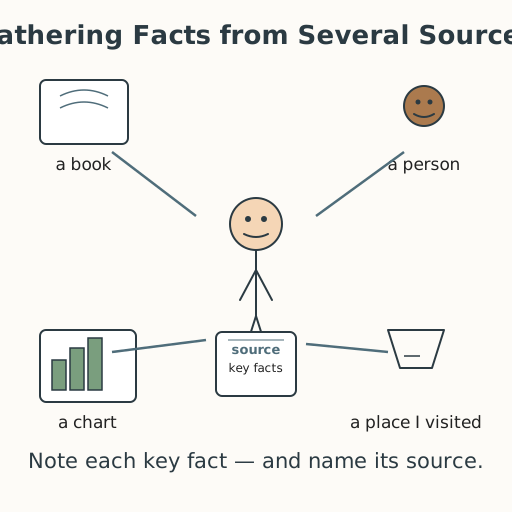
- Sources poster · 1 A poster showing several kinds of sources — a book, a person, a chart, a labeled picture, a place visited — each feeding a note card
- Note-card page · several per learner A page of blank note cards, each with a line for "source" and lines for "key facts"
- A small research topic menu · 1 per learner A list of simple, local, checkable topics — a plant, an animal, a food, a tool, a festival, a job — learners may research
Low-tech / no-cost
- A person as a source Interview a knowledgeable person nearby — an elder, a gardener, a craftsperson — and record key facts they share
- Observation as a source Watch something closely — a plant, a bird, a tool at work — and note the key facts you can see
Enriched / lab & device
- A small source set · 1 per group A few short printed or digital sources on one topic for learners to compare and take notes from
- A 'which source?' wall · 1 A shared wall where learners post a fact, the source it came from, and a second source that agrees
Works in different contexts
- large-group Model gathering facts from two sources on one shared topic, then have learners gather from their own sources in small groups
- multi-age Younger learners gather one or two facts from one source while older learners gather from several and compare them
- self-directed A learner picks a topic, finds two or three sources, and records key facts on note cards with each source named
- level-grouped Learners ready to extend compare two sources that disagree and note what they would check next
- outdoor-only Research a real plant, animal, or place outside using observation plus one person as sources, and record key facts
Lesson 11 — Gathering Facts from Several Sources
Summary
Learners learn to gather information from several sources and note key facts. They meet different kinds of sources (a book, a person, a chart, a place), practice turning what they find into short notes that name the source, and begin the research that will become a short report in the next lesson.
Objectives
- Gather information from several sources and note key facts. (D04.S3.05.02)
Connection
How do you know whether a plant is safe to eat, or what time the market opens, or how a tool works? Not from one guess — from several sources: you ask someone who knows, you watch it yourself, you check a book or a sign. A careful person doesn’t trust a single source; they gather from a few and write down the key facts. That is what research is: collecting the best available truth, from more than one place, and keeping track of where each bit came from.
Materials
- Sources poster
- Note-card page
- A small research topic menu
Preparation
- Print or draw the sources poster (book, person, chart, place → note card).
- Copy several note-card pages per learner.
- Prepare a menu of simple, local, checkable topics.
Facilitator note
This lesson is written to the learner (“you”). The ideas to land are that research means
gathering from several sources and that a good note records both the fact and its source.
Make “sources” wide — a person, a place, a chart, an object — so the skill is not limited to
books, which many learners may not have. Model taking a note from two sources on one topic,
then let learners choose topics they can actually investigate in their own lives. This is the
first half of the research arc; the next lesson turns the notes into a report in the learner’s
own words. See docs/contexts.md on low-resource research.
Procedure
- Gather (5 min). Think of something you’d like to know for certain — about a plant, an animal, a food, a place, a job. Today you become a researcher: you gather facts from more than one source and write them down.
- Meet sources (10 min). Look at the poster. A source is anywhere a fact comes from: a book, a person who knows, a chart, a place you visited, an object you examined. Good research uses several sources, not just one — because one source can be wrong, and several that agree are stronger.
- Learn to note a key fact (10 min). Look at a note card. It has two parts: the source (where the fact came from) and the key facts (the important bits, in short words). A key fact is not every word — it is the heart. Practice: from a fact your facilitator says aloud, write one key-fact note with the source named.
- Gather from your sources (15 min). Choose a topic from the menu (or your own). Find two or three sources — ask a person, watch something, check a book or sign. For each, fill a note card: source on top, key facts below.
- Compare your sources (10 min). Look at your cards. Which facts appear in more than one source? A fact two sources agree on is one you can trust more. Circle those.
- Close (5 min). You now have the raw material of research — key facts, with their sources kept safe. Next lesson, you will turn these notes into a short report in your own words.
Differentiation
- Support: Provide a pre-filled source line and a sentence frame (“From ___, I learned that ___.”); allow one source to start.
- Extension: Gather from three or more sources, and note a place where two sources disagree and what you would check next.
Assessment
- Formative (observation/portfolio): Does each note card record a key fact and name its source, drawn from more than one source?
- Self-check: The learner asks, “For every fact I wrote, could I point to which source it came from — and did I use more than one source?”
Home connection
Ask two different people at home the same question — and compare their answers, noticing which facts they agree on.
Resources
- Gathering and corroborating information across sources is a foundational research skill; see
the IES “Improving Adolescent Literacy” practice guide and Graham & Perin, “Writing Next”
(Carnegie Corporation, 2007). On source credibility as a habit, see
docs/philosophy.md§7.