Lesson 14 — Using Conversions to Solve Real Problems
Learners use measurement conversions to solve real multi-step problems: combining liquid amounts in different units, converting a distance to compare it, and comparing masses. They convert first so units match, then compute, and check that answers make sense.
Objectives
Objectives
- D05.S4.05.01 Convert among different-sized standard measurement units and use the conversions to solve real problems.
Essential question
How do I use measurement conversions to solve real problems?
Key vocabulary
Materials
Standard materials
- Real-problem conversion cards · 1 set per group Cards with multi-step problems: recipes, distances, and masses that need conversion to compare or combine
- Problem-solving page · 1 per learner A page with space to show conversions and the steps of each problem
- Unit conversion chart · 1 The chart from Lesson 13 for reference while solving
Low-tech / no-cost
- Real objects and measures Solve real problems with actual amounts — combine two bottles of water in different units, compare two distances walked
- Drawn pictures Draw the problem (jugs, routes, bags) in the dirt or on paper and convert the amounts to solve it
Enriched / lab & device
- A kitchen or market simulation · 1 A real scenario where learners measure, convert, and combine amounts to complete a task, where resources allow
- A digital converter for checking · 1 per group A converter to check hand-computed answers, where devices allow
Works in different contexts
- large-group Solve one multi-step problem together, then have groups solve cards and share one strategy
- multi-age Younger learners do the single conversion step while older learners plan the whole multi-step solution
- self-directed A learner solves the problem cards alone, showing conversions and checking against the worked example
- level-grouped Learners ready to extend design their own real problem that needs two conversions and solve it
- outdoor-only Use real outdoor amounts — distances walked, water collected, gathered produce — and convert to compare or combine them
Lesson 14 — Using Conversions to Solve Real Problems
Summary
Learners use conversions to solve real problems: combining liquid amounts in different units, converting a distance to compare it, and comparing masses. The habit is convert first so the units match, then compute, then check that the answer makes sense.
Objectives
- Use measurement conversions to solve real multi-step problems. (D05.S4.05.01)
Connection
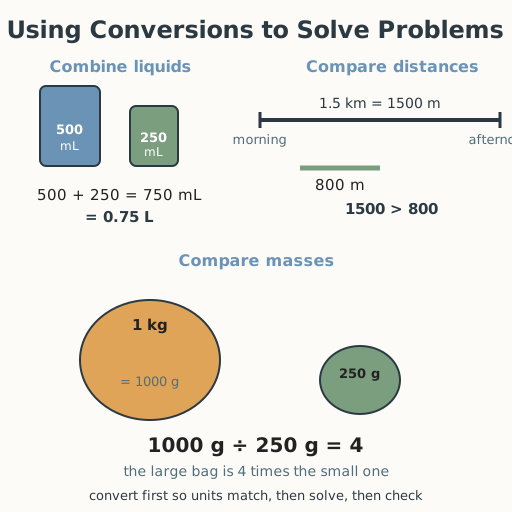
A cook has a 500 mL jug and a 250 mL cup of water. How much is that altogether, in liters? Convert first: 500 + 250 = 750 mL, and 750 mL = 0.75 L. A runner walked 1.5 km this morning and 800 m this afternoon — who walked farther? Convert: 1.5 km = 1500 m, so the morning was longer. Conversions are not just an exercise — they are how people compare and combine real amounts in kitchens, fields, and clinics everywhere.
Materials
- Real-problem conversion cards
- Problem-solving page
- Unit conversion chart (from Lesson 13)
Preparation
- Copy problem cards for groups and the problem-solving page.
- Have the conversion chart ready for reference.
- Have worked examples ready: 500 mL + 250 mL = 0.75 L; 1.5 km vs 800 m.
Facilitator note
This lesson is written to the learner (“you”). The idea to land: when amounts are in
different units, convert so they match before you add, subtract, or compare — then solve, and
check the answer is sensible. Model a worked example first, then guide a second (Kirschner,
Sweller & Clark, 2006). Common slip: adding or comparing without converting first (500 mL + 250
mL is fine because both are mL, but 1.5 km + 800 m is not yet). Retrieval: ask learners to recall
Lesson 13’s conversion rule and reuse it. Emphasize estimation to catch errors. The math is
evidence; the fairness value appears in making sure everyone gets the same measure — no one
short-changed when amounts are combined or shared (docs/philosophy.md §4).
Procedure
- Gather (5 min). Recall: how do you convert 1.5 L to mL? Today you use conversions to solve real problems.
- The strategy (5 min). When amounts are in different units, convert first so they match. Then add, subtract, or compare. Then check: does the answer make sense?
- Worked example — combine (10 min). A cook has 500 mL and 250 mL of water. Total: 500 + 250 = 750 mL. Convert to liters: 750 mL = 0.75 L.
- Worked example — compare (10 min). A runner walked 1.5 km and 800 m. Convert: 1.5 km = 1500 m. Now compare: 1500 m > 800 m, so the first walk was longer, by 1500 − 800 = 700 m.
- Practice with a partner (15 min). Take your problem cards. For each, decide which units to convert, convert first, then solve, and check the answer makes sense. Check each other: did we convert before computing?
- Close (5 min). Conversions let you compare and combine anything, as long as the units match first. Convert, then solve, then check — that is the whole recipe.
Differentiation
- Support: Use problems with one conversion step and keep the chart visible; describe each step aloud. Use real water or objects so learners with low vision can follow by feel.
- Extension: Design an original problem that needs two conversions and solve it, then trade with a partner.
Assessment
- Formative (observation/self): Can the learner convert units to solve a multi-step real problem and check that the answer is sensible?
- Self-check: The learner asks, “Did I convert so the units matched before computing? Does my answer make sense for the real situation?”
Home connection
Find two amounts at home in different units (two bottles, two distances, two bags) and convert them to compare or combine them.
Resources
- Using conversions to solve problems is standard in elementary mathematics; see John A. Van de
Walle, Elementary and Middle School Mathematics (10th ed., 2019). The fairness value of
equal, honest measures in sharing is a commitment (
docs/philosophy.md§4).