Lesson 07 — Identity Across Time and Place
Learners examine how identity is historically and culturally constructed by comparing how different cultures and eras name their members, mark belonging, and decide what a person is — and take from the comparison a clearer view of what is universal and what is chosen.
Objectives
Objectives
- D01.S2.10.01 Examine how identity is socially and historically constructed, comparing examples across cultures.
Essential question
How has identity been constructed differently across cultures and across history?
Key vocabulary
Materials
Standard materials
- Identity comparison chart · 1 per pair Columns for two cultures or eras — how each names its members, what marks belonging, what it values — and a row for "what I take and what I question"
- Short source excerpts (optional) · 1 set per group Brief, age-appropriate readings describing identity in two or three cultures or eras
Low-tech / no-cost
- Paper and pencil Draw the comparison chart by hand
- Elders' or community members' stories Learners interview or recall how their own community has named its members across generations
Enriched / lab & device
- Online encyclopedia or library access · 1 per group To research a chosen culture's or era's identity markers from reliable sources
- Short documentary clips · as available Clips showing identity roles in two contrasting cultures or historical periods
Works in different contexts
- large-group Compare two examples whole-class on a shared chart, then pairs research and compare a third
- multi-age Younger learners compare one marker (e.g., how a community names its members); older learners compare several and weigh what changed and why
- self-directed A learner chooses two cultures or eras from the source excerpts, completes the chart alone, and writes a short reflection
- level-grouped Learners ready to extend analyze *why* a culture's identity markers took their shape — connecting identity to history, economy, and belief
- outdoor-only Use printed or remembered source excerpts and complete the chart on paper outdoors, then share in a circle
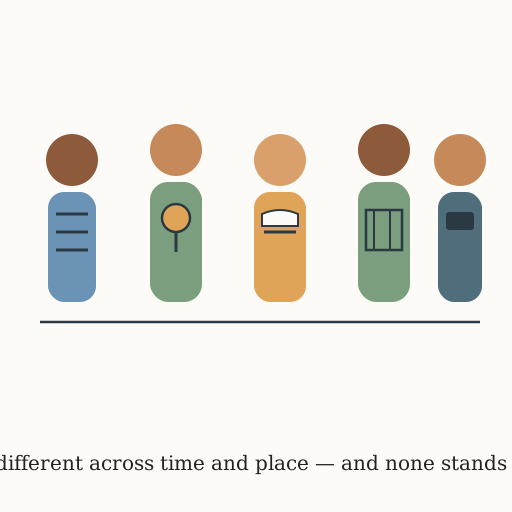
Lesson 7 — Identity Across Time and Place
Summary
Learners examine how identity is historically and culturally constructed by comparing examples across cultures and eras. They ask how different peoples have named their members — by kinship, clan, caste, craft, faith, language, age, or achievement — what marked belonging, and what each valued. The comparison is not a ranking but a mirror: seeing that identity has been built differently everywhere shows the learner which of their own parts are inherited, which are chosen, and which are up to them.
Objectives
- Examine how identity is socially and historically constructed, comparing examples across cultures. (D01.S2.10.01)
Connection
In one community, who you are may be told by your family line; in another, by the craft your hands learned; in another, by the faith you keep; in yet another, by the school you passed into or the team you joined. There is no single “right” way to be someone — human beings have built identity out of every one of these materials, in every corner of the world and every century. Studying how others have done it is like holding your own identity up to a series of mirrors: you see more clearly which of your parts are gifts, which are choices, and which you might remake.
Materials
- Identity comparison chart (two cultures or eras, plus a “what I take / what I question” row)
- Short source excerpts (optional)
Preparation
- Copy or draw the comparison chart; gather the source excerpts.
- Retrieval: from Lesson 6, recall that identity is socially constructed. Today we add the second half: it is historically constructed too — it changes from place to place and era to era, and we can see that by comparing.
Facilitator note
This lesson is written to the learner (“you”). The idea to land: identity is not fixed by nature alone; it is constructed differently across cultures and history — and comparing examples makes the constructed, chosen, and inherited parts of our own identity visible. The framing is anthropological and global by design: no culture’s way of being someone is above another’s (philosophy §4, §11). Keep examples accurate and respectful — describe each culture’s identity markers from within as far as possible, credit real peoples and traditions, and avoid turning anyone into a “specimen” or a cartoon. The standard (D01.S2.10.01) is explicitly comparative and cross-cultural, so the comparison itself is the skill being taught.
Model the comparison skill once, then let learners practice (S-011). The global lens is the heart: choose examples from more than one region and era, and hold them side by side without ranking. The egalitarian lens: ask whose ways of being someone have been treated as “the normal one” and whose have been called “exotic” — and name that imbalance. The ethics lens: comparison is for understanding, not for judging another people’s way of life; respect means asking questions a community would recognize as its own. The technology & environment lens: how identity is made is itself changing — mass media and the internet now carry identity markers across the world, mixing and sometimes flattening them (recall the feeds of Lesson 3); and the land and climate people live in shape how they live and thus who they become. The social-emotional lens: learners are themselves mid-formation (S-403 describes exploration as healthy and normal); keep the tone affirming — there is no deadline for becoming, and uncertainty is part of the work, not a failure.
Procedure
- Recall (5 min). From Lesson 6: much of what you “know” about yourself was written by other hands. Today: those hands write differently in every time and place.
- Meet the comparison chart (10 min). Look at two worked examples side by side — for instance, a community that names its members by clan and lineage, and one that names them by chosen craft or profession. For each, note: how does it name its members? what marks belonging? what does it value? Notice that neither is “more true” — each is a different answer to the question what is a person?
- Compare two cultures or eras (20 min). In pairs, choose two examples from the source excerpts (or from your own and a neighbor’s community). Fill the chart: how each names its members, what marks belonging, what it values — and what changed for each across history. If you use your own community, treat it with the same respectful curiosity you would bring to a distant one.
- Take and question (10 min). Fill the final row: from each example, what would I want to keep for myself, and what would I question? Be specific — name one idea about being a person that you are glad to inherit, and one you would like to rewrite.
- Draft (7 min). Write or record a few sentences: identity has been built differently everywhere, which shows me that much of who I am is made, not fixed — and that some of it is mine to make.
- Close (3 min). Remember: studying how others became themselves is not a search for the one right way. It is a search for the many ways — and a clearer view of your own.
Differentiation
- Support: Offer a single comparison with pre-filled rows and a sentence starter (“This community says a person is ___, while that one says a person is ___.”).
- Extension: Explain why a culture’s identity markers took their shape — connecting them to history, economy, belief, or environment — and name one way a modern technology is now changing that shape.
Assessment
- Formative (peer): Can each pair state, for two examples, how each names its members and what marks belonging — and name one thing they would keep and one they would question?
- Portfolio artifact (summative for the unit): The completed comparison chart, added to the unit portfolio.
Home connection
Ask an older family member or elder: how did our community name people when you were young, and how is it different now? Listen for what changed and what stayed.
Resources
- On identity formation as exploration and commitment (context for “mid-formation”): Marcia (1966), “Development and Validation of Ego-Identity Status,” JPSP 3(5), 551–558 (S-403).
- On identity as an evolving life story: McAdams (2001), “The Psychology of Life Stories,” Review of General Psychology 5(2), 100–122 (S-404).
- On modeling + guided practice: Kirschner, Sweller & Clark (2006), https://doi.org/10.1207/s15326985ep4102_1 (S-011).